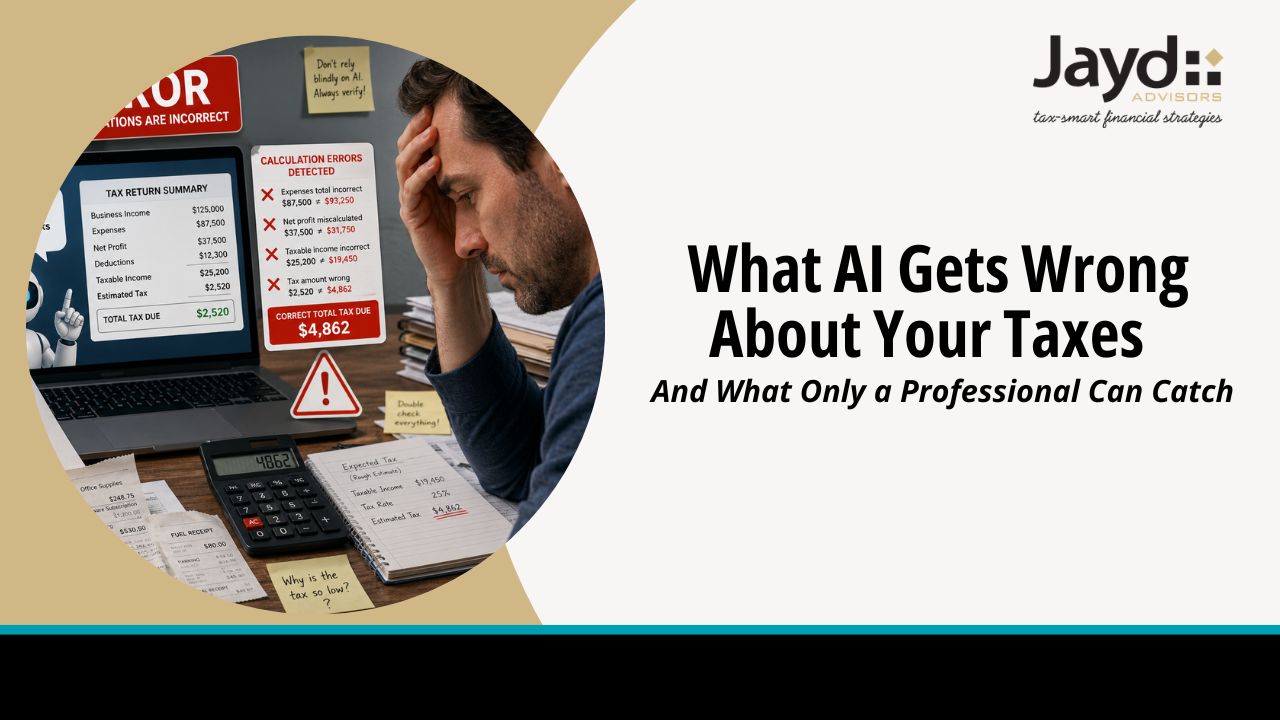
What AI Gets Wrong About Your Taxes — And What Only a Professional Can Catch
You typed a tax question into an AI tool, got back a clear, confident answer, and either felt reassured — or found yourself wondering whether to trust it.
AI tools have made a lot of things faster and easier. Tax planning is not one of them. Not entirely, anyway. And understanding where the line is could save you from a costly mistake — or from leaving money on the table because you didn't know what questions to ask in the first place.
Where AI actually helps
AI has real value in the world of finance and tax preparation, and it's going to continue to improve.
It's useful for reading and processing documents quickly. It's getting better at linking platforms and reducing the manual work of data entry — something that has historically made tax season feel overwhelming for clients and advisors alike. It can help identify patterns in data at a speed no human can match.
These are genuine benefits, and they're worth acknowledging. At Jayd Advisors, we pay attention to where technology is improving the process — because anything that reduces the burden of paperwork creates more time for the planning conversations that actually matter.
Where AI falls short — and why it matters for your situation
Here's the part that most people don't realize until something goes wrong.
It struggles with dates and time-sensitive limits
Tax law changes constantly. Contribution limits adjust almost every year. Brackets shift. Thresholds move. AI tools are trained on data up to a certain point — and they are notably poor at accurately associating rules and limits to a specific tax year.
The result? You might be working from limits that applied two years ago without knowing it. Underfunding a retirement account because the ceiling was lower in the training data. Or overfunding one and creating a correction you'll need to unravel later — a process that costs both time and money.
It doesn't understand how your pieces fit together
Tax strategy isn't a list of independent deductions. It's a system — puzzle pieces and gears where moving one thing changes something else entirely.
AI can answer the question you asked. What it can't do is recognize the question you didn't ask — the one that reveals that your retirement contribution strategy is quietly working against your QBI deduction, or that your capital gains timing is about to affect your Medicare premiums two years from now.
A professional who knows your situation looks at all of those pieces at once. An AI tool answers one question at a time, in isolation, without knowing what's sitting next to it in your financial picture.
It doesn't know you
This one matters more than it sounds. Tax planning isn't purely mechanical. How you feel about locking up funds in a retirement account. Whether you're planning a major transaction next year. What your income is likely to look like in five years versus today. What you're trying to build, preserve, or pass on.
An AI tool can give you decent ideas to consider. A professional who understands your relationship and what's actually important to you will help you build a plan adjusted to your goals — not just a plan that can work in theory.
A real example: the overtime tax myth
One of the clearest illustrations of AI's limitations right now is playing out on social media.
Many people have seen content — often confidently stated — suggesting that overtime pay is not taxable. It's a half-truth that has spread quickly. The reality is more nuanced: it's specifically the incremental overtime premium (the "half" in time-and-a-half) that may qualify, not the full overtime amount. And for employees paid under certain union labor agreements, overtime may appear on a pay stub without meeting the 40-hour weekly threshold that actually triggers the exemption.
Someone relying on a quick AI search for clarity on this could make withholding decisions, budgeting assumptions, or even business payroll decisions based on an incomplete picture. The gap between the social media version and the accurate version is real — and consequential.
The right way to use AI in your tax life
None of this means avoiding AI entirely. It means using it with the right expectations.
Use it to educate yourself on concepts. Use it to generate questions worth asking your advisor. Use it to reduce the burden of document gathering and data entry. And then bring what you've found to a professional who can tell you whether it applies to your situation, in this tax year, with your specific set of circumstances.
That's not a knock on technology. It's how every tool works best — in the hands of someone who knows what they're doing with it.
Tax season readiness starts now
August might feel far from tax season. But the decisions made between now and year-end are often the ones that determine what filing season looks like — for better or worse.
If you've been relying on search results or AI tools to answer your tax questions, this is a good time to have a real conversation. Not to replace curiosity, but to make sure what you've found actually applies to you.
At Jayd Advisors, we're here throughout the year — and that's exactly when the best planning happens. Not in March when the deadline is close, but now, when there's still time to act.
Ready to move from reactive to proactive on your tax strategy?